(And What, Exactly, Did He Have in Mind?)" New York Magazine, December 13, 1971 issue
By Carol Troy (©1971)
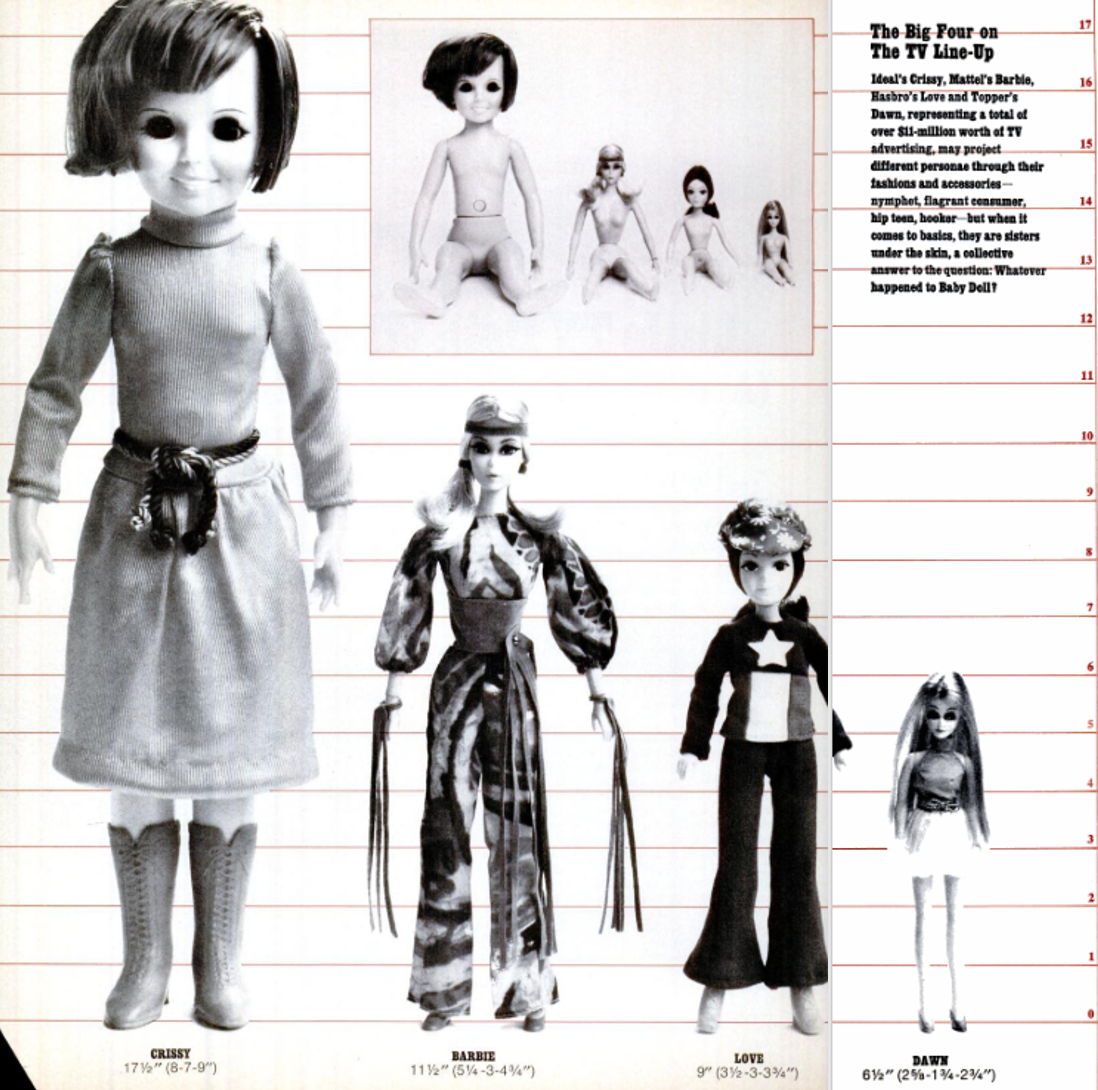
Article synopsis by NYM: Long ago, a doll was almost always a model of a baby or a very small child, and was given to a little girl as a sort of prelude to her own motherhood. Now the doll has undergone a tremendous transformation. The most popular models are - thanks to over $11 million worth of TV advertising - teenage hookers or hipsters going by such names as Barbie, Love, Crissy or Dawn. Through them, the child is given a model of a new identity for herself. Lots of luck. Miss Troy, formerly with Rags, is fashion editor of L.I., Newsday's new Sunday magazine.
Copyrighted material, not for reprint or sale.
In the Great Before, before TV, before generation gaps, the baby doll was among other things, a training instrument for eventual motherhood, the ultimate role goal for little daughter. But now? We spin around and stare back at one of these teen "fashion dolls" and, by God, she's not just an innocent little doll anymore. She's peddling a whole lifestyle, an ongoing identity.
Mike Helfgott, a former professor of social psychology whose agency, Helfgott and Partners, is chief consultant to the Ideal Toy Company, says, "These dolls are the way a child works out her inner systems. Each doll is another human possibility. We're stressing the clothes a lot more now, because through them kids can play with their own adolescence, their own ego states. And if you know how to read the language of what people choose to wear, it tells you an awful lot."
It tells you we are witnessing childhood's end, for one thing: the new kiddie culture identifies with young teens rather than good old Mom. In fact, these kids who, according to the Nielsen ratings, spend an average of 54 hours a week in front of the TV, have no real concept of what being a "child" is all about. But perhaps the implications of all this will become clearer when you see how Barbie and Dawn and Crissy and Love, these little "human possibilities," were born, how they grew and what it took to get them into your house.
Ideal's Crissy: b. 1969, Queens, New York, ht. 17 1/2", measurements 8-7-9". Friends: Black Crissy, Velvet, Black Velvet, Kerry ("from the Emerald Isle"), and Mia. '71 Models: Talky Crissy, Movin' Groovin Crissy (with a swivel waist). Fashions, including garment bag with hanger, include: the Hob Nobber (peplum maxi-suit) Jean Machine (tie-dye pizza T-shirt over long-sleeved T-shirt and patterned jeans), Gypsy (aqua satin midi with fringed shawl), five more. Accessories: Hair Dryer, Shoe Assortment ("vitally important additional accessories"), Clothes Rack with Garment Bags, Crissy Hair Styling ("1 brush, 1 comb, 1 curler set that uses 1 AA type battery [not included], 1 can simulated hair spray, 8 curlers, 1 makeup mirror, 1 style book"), and the Crissy and Velvet Shopping Spree Game (By bidding for merchandise of undisclosed value, by earning payment for performance of various chores, by receiving gifts and by borrowing money on merchandise owned, players compete to accumulate the greatest total of cash and commodity value. An exciting experience in speculation and manipulation.").
The Ideal Toy Corporation has been around since 1902, when Morris Michtom, owner of a Brooklyn candy store, came up with the idea of the "Teddy Bear" after seeing a newspaper cartoon about President Teddy Roosevelt's latest hunting trip. The company was, as they say, off and running.
Then, in 1969, Beautiful Crissy was introduced by Ideal. With the seventeen-and-a-half inch redhaired Crissy, Ideal had something really new! A push of a belly button, and Crissy's hair grows (not, actually, squiggling in and out at the roots but growing ponytail style from the approximate location of the soft spot on a normal youngster). The hair-growing feature was Crissy's "marketing niche." But now that everyone has knocked it off, Crissy, too, is becoming a fashion doll. According to Herb Sand, V.P. of marketing, Ideal is going further with Crissy - which means "developing additional fashions, accessories, to fulfill the child in extending 'play value.' That's being very open ended, an important phrase in the toy business."
Sand mentioned a recent trip to Cincinnati, where the drippy J.C. Penney styles of the mothers just were not, for some mysterious reason, filtering down to the kids. If there is a kiddie culture loose in the land, Ideal is trying to stay on top of it. Sand is also wondering about the effect of youth culture on the parents: "What's the profile of today's young marrieds? The people born in the baby boom after World War II? How do we approach these people?"
Ideal, apparently feels it is beginning to traffic with a different group of buyers ... the younger, "Naderized" parents. This fall Ideal pulled out of Saturday and Sunday "kiddie ghetto" network TV sponsorship, switched to football and family shows like The Partridge Family and bought total Crissy sponsorship of Rudolph, the Red-Nosed Reindeer. Their thinking is that if both parents and kids see the commercials together, a "buying decision" can be reached right then and there, in front of the tube.
Overseeing Crissy's movement into the world of fashion will be one Arty Albert, who had been described to me by Ideal's ad agency head as a Doll Genius. According to Mike Helfgott, "I'll come up with a great storyboard and Arty will say 'Not for Crissy you don't! She doesn't do things like that.' It's incredible! He's brilliant at 'imaging a doll, coming up with a whole concept, a person." So ... I got a ride out to Ideal's Hollis, Queens, factory and visited with Arty Albert, doll product manager, and Judy Paruolo, his assistant for ten years and Ideal's chief doll clothes designer.
Arty, to keep in touch, is always reading, reading, reading. The Female Eunuch, Future Shock, The Prisoner of Sex, Touching ... and probably some of Helfgott's favorites like McLuhan, Leary, Castaneda's The Teachings of Don Juan, Alpert's Be Here Now, Roszak's Making of a Counter Culture, Laing's Politics of Experience, William Irwin Thompson's At the Edge of History ... "Your brain is like a computer," says Arty. "The more you read into it, the better ideas you will evolve. Now Judy, she operates more on instinct. She'll get a gut feeling about something, like how important hair became a few years back, and say, 'I can feel it, I can feel it.' And she's usually right..."
"We really do make dolls we really love, says Arty, shlumped back behind his desk in a rumpled brown corduroy suit and turtleneck. "Of course, we're forced to make compromises by the upper management to bring the doll in at a certain price. The higher-ups have less vision as to form ... they think in terms of dollars, while the middle echelon has more imagination."
Last year Judy designed a midi for the Movin' Groovin' Crissy. "Management started backing off on it ... they thought we were either picking the wrong trend or hitting it too soon. But what they didn't realize is that change is reality to these kids. Even with a child of two, the most important influence can be television. Often, she is abandoned to this box. Lots of parents dump a box of sugar-coated Cheerios into the kid's crib and train it to turn on the set itself in the morning. No crying. So for a child, it's nothing startling to see a longer dress, because everything is constantly new on TV. They have no preconceived notions as to how things 'should' look."
A lot is riding on Arty and Judy's intuition. At Ideal, the cost of coming up with a new doll concept would be about $400,000 for development of the idea plus a minimum of $300,000 on advertising. At Topper or Mattel it climbs into the millions.
The intuition they had about Crissy was that long hair was something the kids would find very sensuous, and that her slimmer, freer thirteen-year-old's body with the barely budding breasts was more relevant to the kids' world today than Barbie's Carol Doda'isms. (According to Mike Helfgott, teen bodies are changing toward the kind of uni-sexual, skinny, flat-chested, emaciated look of Susan Dey and David Cassidy on The Partridge Family TV show. I've got an old-fashioned body, says Helfgott. "It's a fifties Marlon Brando body with broad shoulders, a low center of gravity ... and of course his counterparts, women who are "built" or "stacked" like Barbie ... they're out of it too).
A motivational researcher who tests dolls with little girls says the fashion dolls represent a very tricky mix of reality and fantasy. If the child is still very young, she will play the mother ... if the mother is constantly fussing with her hair and caressing her mink stole, the little girl will want a doll like Barbie ... and the mother will want it for her little girl. But once the peer group starts to get more important - around six or seven or eight - the child starts to look longingly at the freedom of the younger teens, whose clothes are free, whose hair is free. And apparently Ideal thinks Crissy's small breasts and long hair get the freedom across. Arty and Judy are now thinking of introducing an "indication of nipples" on Crissy's flat little bust.
Judy was trained as a designer at the Fashion Institute of Technology in Manhattan, a school sponsored by the garment industry (the state's biggest business) and part of the State University of New York. She takes her job as a doll clothes designer very seriously. She comes to Manhattan about three times a week to see what's cooking in the stores and on the street. For high fashion, she and Arty take a monthly Grand Tour - browsing through Madison Avenue boutiques like St. Laurent's Rive Gauche and Valentino's. At the office, she and her assistants study Women's Wear Daily, Vogue, Mademoiselle, Glamour, Ingenue and Rags (before it folded) ... and French Vogue, Marie Claire, Jardin des Modes, Elle, L'Officiel, and Vanidades. Their latest "collection" - sixteen outfits for Crissy and sixteen for her smaller friend Velvet - is a dressed-down look inspired by street looks in Rags ... funky jeans and T-shirts right down to all the little detailing (like patterned leather belts) and accessories (like wedgies) that matter drastically to kids.
Under Judy are two assistant designers, Aline Ryan, who answered an ad in The Village Voice, studied a year at Parsons (New York's other influential design school). She's around twenty, lives in the Village, and has an eye for funk. Salvado Rupert, a self effacing young man from Spain, was trained in the classic couture under Balenciaga. "Rupert was so tight when he first came here," says Arty. "It was a year and a half before he could make a doll dress. He was crazy! Too stiff! He'd put in hidden seams, weighted hems, pocket detailing, interlinings. He wanted Crissy's clothes to look expensive! I'd go into the workroom and pick up a dress and it would weigh two pounds!!!" Doll clothes, Rupert would learn, are Sachs Quality Mediterranean furniture: more for effect than substance.
This is how is how Crissy's "collections" evolve: Judy starts out with a "feeling" and tries to turn it into something sensuous with a bright, happy color and a special fabric. Then, from sketches of the line, they make up three perfect samples for each outfit, along with a very specific pattern and an instruction booklet with a list of all the details that will not be changed and cannot be tampered with. All this goes off to the factory in Hong Kong. Then the Telexes start flying back and forth. "Just try explaining a color or fit on a Telex," says Judy, who is like a Betsey Johnson fighting mass manufacturer for a special heart-shaped plastic button. She has a passion for the little details, for perfection.
Crissy, like Barbie, Dawn and Love, is uniquely American in countenance. Crissy, for instance, is made in Hong Kong under a licensing agreement for foreign sales. She is sold in France. But the French couldn't deal with her face, that precocious-young teen look. They stuck on a new head with a younger "dolly" look, because over in Europe they still have a latency period and little girls are little girls through fifteen or sixteen. And the French even hired Pierre Cardin to do clothes for Crissy. "Pierre Cardin could never do a doll's dress as good as Judy!" snorts Arty.
And I'm sure he's right.
New York Magazine, December 13, 1971 issue
All rights reserved by owner.
©December 1971, not available for commercial use.
